Today is the 91st birthday of HM King Michael of Romania!
Bellow is the article in the British monthly magazine “Majesty” published last year, authored by Diana and the undersigned celebrating His Majesty’s life and achievements:

Valentin Mandache, architectural historian
Considerations on the built heritage of southeast Europe
Today is the 91st birthday of HM King Michael of Romania!
Bellow is the article in the British monthly magazine “Majesty” published last year, authored by Diana and the undersigned celebrating His Majesty’s life and achievements:
Bellow is the article in the British monthly magazine “Majesty” published in their October 2011 issue, authored by Diana and the undersigned with the occasion of the celebration of King Michael of Romania‘s 90th birthday on 25 October last year.
This article has initially been published in Diana Mandache’s blog on Royal History.
Romania tomorrow, 10 May 2011, celebrates 130 years since the coronation of King Carol I and Queen Elizabeth as the first sovereigns of the Kingdom of Romania, an event which marked the inauguration of the most prosperous period in the country’s history, an era when a majority of its historic architecture edifices were built. That epoch of great achievements and organic development was cut short by the communist takeover of December 1947, which gave way to a long and catastrophic decline from which the country has not yet recovered.
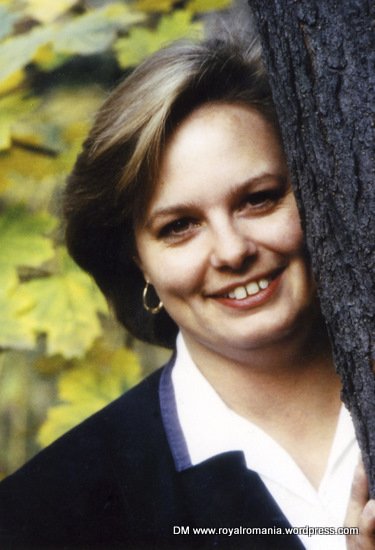
H.R.H. The Princess Sophie of Romania is the fourth daughter of King Michael of Romania. She goes by “Sophie de Roumanie” professionally. Princess Sophie studied Fine Arts at the University of North Carolina, Asheville, and Graphic Design and Photography at the Corcoran College of Art and Design in Washington, D.C.
http://aphotognamedsophie.blogspot.com/
*****
All rights reserved Diana Mandache’s Weblog: Royal History
Because the whole planet seems now captivated by the recent wedding of Prince William and Catherine Middleton, now Duchess of Cambridge, I thought it would be a good idea to post an article touching the subject of historic Romanian architecture in the context of another wedding, more than a century ago, involving Romanian royals. Bellow is a very rare old postcard depicting the official cavalcade accompanying Marie, the Princess of Edinburgh, freshly made a Princess of Romania through the marriage with Crown Prince Ferdinand, when she first arrived, after the marriage ceremony and honeymoon, in her adopted country on the 24 January (4 Feb.- Julian calendar) 1893. Marie’s coach is seen acclaimed by Bucharest’s citizens, passing by two of the city’s architectural landmarks of the late Victorian era: the Unirii Market Hall (in the background), a large and beautiful iron frame structure similar with the ubiquitous Les Halles Centrales found in many of the late c19th French towns and the majestic Beaux Arts style building of the Brancovensc Hospital Establishment (in the foreground). Both these wonderful edifices, so important for Bucharest’s identity, were savagely demolished by the communist authorities in the mid-1980s, during dictator Ceausescu’s infamous vast and architecturally coarse remodelling of large areas of central Bucharest for his infamous “Victory of Socialism” project. That area is today full of ugly and badly maintained massive communist apartment blocks, which are also among the most expensive properties in Romania’s capital- a measure of the dismal level of culture and confused identity of the post-communist inhabitants of this city.
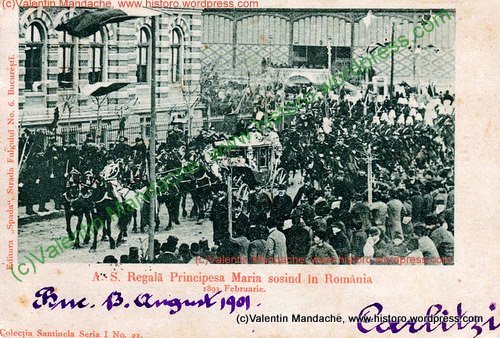
For more information on Queen Marie of Romania see “Marie of Romania. Images of a Queen” by Diana Mandache, Rosvall Royal Books, 2007.
***********************************************
I endeavour through this series of periodic articles to inspire appreciation of the historic houses of Romania, a virtually undiscovered, but fascinating chapter of European architectural history and heritage.
***********************************************
If you plan acquiring or selling a historic property in Romania or start a renovation project, I would be delighted to advice you in sourcing and transacting the property, specialist research, etc. To discuss your particular plan please see my contact details in the Contact page of this weblog.
This is a trailer from the documentary film entitled “Coroana Romaniei” (“The Crown of Romania”), directed by Marian Baciu from Sahia Studios in Bucharest, produced in 2010. The author of this blog presents within the section dedicated to His Majesty King Michael, together with the historian Diana Mandache who also details the reigns of King Carol I and Carol II. King Ferdinand and his achievements are likewise surveyed.
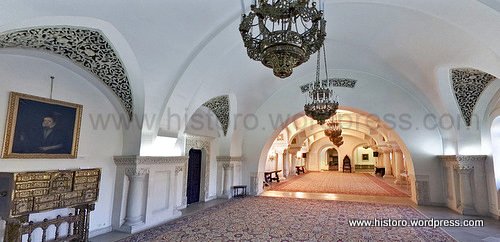
An inclusive descritpion, in Romanian, by the historian Diana Mandache (Fotescu), written in 1992, of the White Hall from Cotroceni Royal Palace in Bucharest. The hall is known today as Cerchez Hall after the architect who re-designed it in the 1920s. The great reception room became a source of inspiration for architects who applied its design principles to their inter-war Neo-Romanian style projects.
***********************************************
I endeavor through this daily series of daily articles to inspire appreciation of the historic houses of Romania, a virtually undiscovered, but fascinating chapter of European architectural history and heritage.
***********************************************
If you plan acquiring a historic property in Romania or start a renovation project, I would be delighted to advice you in sourcing the property, specialist research, planning permissions, restoration project management, etc. To discuss your particular plan please see my contact details in the Contact page of this weblog.

King Michael of Romania’s Christmas 2010 message (via Romania Altfel. A blog by Prince Radu of Romania) - click the image above to access the article [in Romanian].
HRH Princess Margarita of Romania has launched last Saturday, at the “Gaudeamus book fair” in Bucharest, among a wide acclaim from the public and considerable interest from the press, her new book on culinary subjects. The volume is entitled “Royal Cookbook” [“Carte regala de bucate” in Romanian] and is produced by the Curtea Veche publishing house.

The book is a true work of love, the result of personal searches, culinary experiences, encounters and contributions from an important number of European royals with whom the Princess is related or in close friendship. The great distinction of this volume is represented by the small vignettes charmingly portraying its contributors, people from the immediate family like HM King Michel, HM Queen Anne and HRH Prince Radu’s mother to Archduke Georg of Austria or Prince Hassan bin Talal of Jordan. The vignettes interposed between enticing cooking recipes are excellent devices for communicating to the reader the culinary tastes and firsthand glimpses of the daily life and aspirations of HRH Princess Margarita’s family and friends. I very much like the concise and precise writing style of the author, which makes the book a breeze to read and reveals without doubt the leadership genes shared by the princess with her ancestors, distinguished sovereigns of Romania. The Curtea Veche publishing house is to be commended for its acumen in publishing this wonderful book.
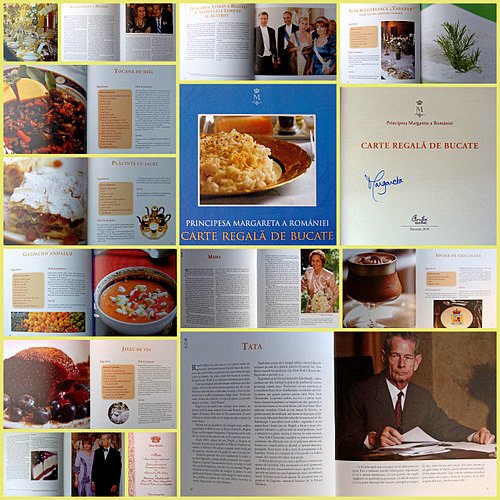
Sharing and talking about food is one of the most convivial human activities, which bring together groups and individuals, managing to break otherwise insurmountable barriers between them. Through this brilliant book, written in a straight forward manner, communicating with ease its hospitality message, the Romanian Royal House has scored very high mark public relations points, which in the more usual daily life circumstances would have necessitated a considerably greater effort and expense. The volume thus represents a direct link with the public that brings the monarchy closer to the people, further blowing away the smokescreen put between them by the uncongenial press and politicians.
Diana and I were among the numerous public that listened to the introductory speech of HRH Princess Margarita at the book fair. The area occupied by the bookstands seemed too small to hold such an enthusiastic crowd that surged forward, with people stepping over each others’ toes to catch a glimpse of the author and get an autograph. As historians, we had thus a delightful opportunity to feel and observe at first hand the huge interest and positive emotion generated by this remarkable event.
Valentin Mandache
 Valentin Mandache, architectural historian