Neo-Romanian style decorative panels

A conspicuous feature of the Neo-Romanian architectural style is represented by the elaborate decorative panels that emphasize areas of the façade or stairway. They contain a wealth of designs centred on a number of motifs inspired from the late medieval Wallachian church decorative panoply such as that of peacocks in the Garden of Eden, protector eagle or lions guarding the gates of Paradise. There are also instances of decorative panels containing non-religious abstract motifs in a variety of designs. Bellow are a few examples from the wealth of such attractive architectural artefacts embellishing Neo-Romanian style houses in Bucharest and Targoviste in southern Romania.

Neo-Romanian style decorative panel, late 1920s house, Dorobanti area, Bucharest. (©Valentin Mandache)

The panel above is a representation of the protector eagle, guarding the Garden of Eden, engaged in a manichean battle with a serpent, the embodiment of evil. The Garden of Eden is envisaged as a luxuriant grape vine full of fruit, with its vines contorted around the eagle in the shape of a Greek cross, an allusion that the supreme deity watches that never ending fight.

Neo-Romanian style decorative panel, early 1930s house, Dacia Boulevard area, Bucharest. (©Valentin Mandache)

The panel from the second photograph is rendered in a more schematic, crisp manner, an indication of the Art Deco influence over the Neo-Romanian style that started to manifest in the early 1930s.

Neo-Romanian style decorative panel, late 1920s house, Targoviste, southern Romania. (©Valentin Mandache)

The image above shows an imaginative decorative use of a loft air vent, rendered in the shape of an abstract Greek cross, covered by a rectangular ironwork pattern containing smaller crosses of that type.

Neo-Romanian style decorative panel, mid-1930s house, Targoviste, southern Romania. (©Valentin Mandache)

This forth decorative panel contains a floral motif that does not have immediate religious references, rendered in an Art Deco manner, a result of the high influence of that style on the Romanian architectural scene in the 1930s.

***********************************************

I endeavor through this daily series of daily articles to inspire appreciation of the historic houses of Romania, a virtually undiscovered, but fascinating chapter of European architectural history and heritage.

***********************************************

If you plan acquiring a historic property in Romania or start a renovation project, I would be delighted to advice you in sourcing the property, specialist research, planning permissions, restoration project management, etc. To discuss your particular plan please see my contact details in the Contact page of this weblog.
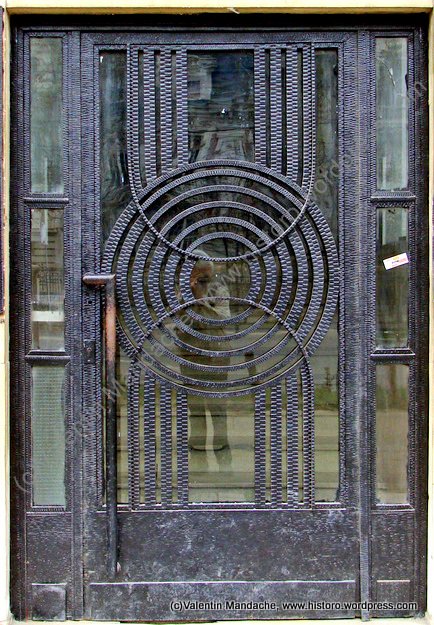
Solar or stage reflector design for Art Deco doorway?

Abstract solar motif design Art Deco style doorway dating from the late 1930s, Romana area, Bucharest (©Valentin Mandache)

I have to say that I pondered a bit on the significance of the Art Deco motif incorporated in the design of the above apartment block doorway in Bucharest and came to the view that it represents either a well rendered solar motif or an abstraction of the lights of a stage/ cinema reflector, frequently represented in Art Deco creations. The high quality of the design is also enhanced by the finely worked wrought iron that has withstood the vicissitudes and lack of maintenance of the past decades in communist and post-communist Romania.

***********************************************

I endeavor through this daily series of daily articles to inspire appreciation of the historic houses of Romania, a virtually undiscovered, but fascinating chapter of European architectural history and heritage.

***********************************************

If you plan acquiring a historic property in Romania or start a renovation project, I would be delighted to advice you in sourcing the property, specialist research, planning permissions, restoration project management, etc. To discuss your particular plan please see my contact details in the Contact page of this weblog.
Field clues for evaluating the construction date of a period house

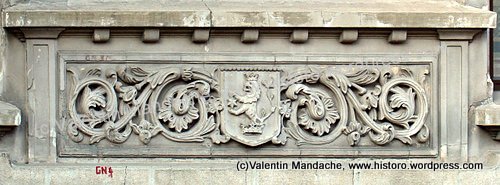
Oltenia's coat of arms within a Neo-Romanian decorative panel, house dating from 1919 - '21, Vasile Lascar area, Bucharest. (©Valentin Mandache)

The Neo-Romanian decorative panel in the photograph above consists of vine branches and leaves, having at its centre the coat of arms of the Oltenia province, a historical region similar in size with Wales, located in south western Romania. The owner of the house wanted probably to state through this representation his origins or connections with this old Romanian province. The heraldic sign comprises of a shield on which is depicted a crowned lion raising up from a ban crown. A ban is an old medieval Hungarian term for regional governor, dating from the times when Oltenia was a Hungarian province, over five centuries ago. The lion also holds between its forelegs a six pointed star. I like how this heraldic sign gives excellent clues about the year when the house was built. It is a version of the coat of arms in use between 1872 and 1921. On the other hand, the panel and the whole house façade is made from moulded concrete, a material which started to be used on a larger scale in Romania after the end of the Great War. Moreover, the typology of the stylised vine branches is also characteristic for the early 1920s. All of these features lead me to the view that the house, or at least this particular house section, has been built sometime between 1919 and 1921. Of course that has to be confirmed with archive documents, but through experience and observation I am by and large positive that I am somewhere close to the construction date stated in deeds. The date thus evaluated helps me better understand in situ the architectural history context of that house, the materials and technologies used and formulate an initial guidance to the house owner regarding the restoration/ renovation of his/her period property or its market value range.

***********************************************

I endeavor through this daily series of daily articles to inspire appreciation of the historic houses of Romania, a virtually undiscovered, but fascinating chapter of European architectural history and heritage.

***********************************************

If you plan acquiring a historic property in Romania or start a renovation project, I would be delighted to advice you in sourcing the property, specialist research, planning permissions, restoration project management, etc. To discuss your particular plan please see my contact details in the Contact page of this weblog.
Lilac leaf shaped Art Nouveau windows

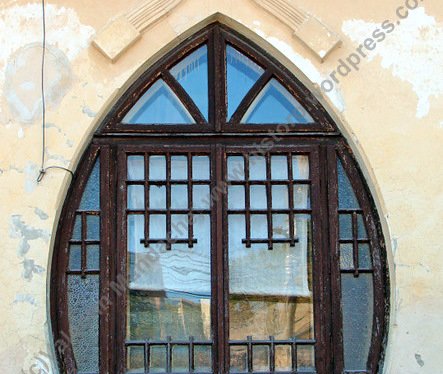
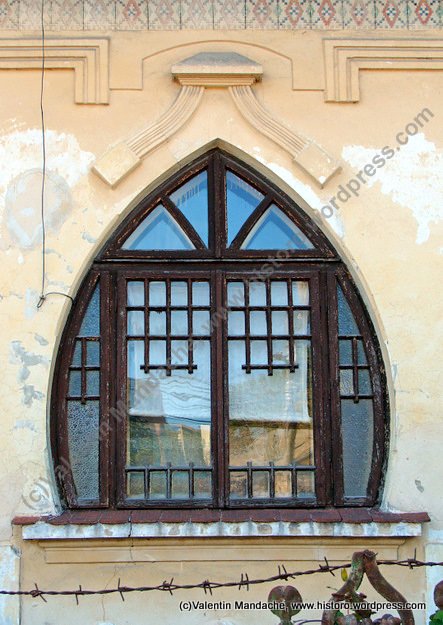
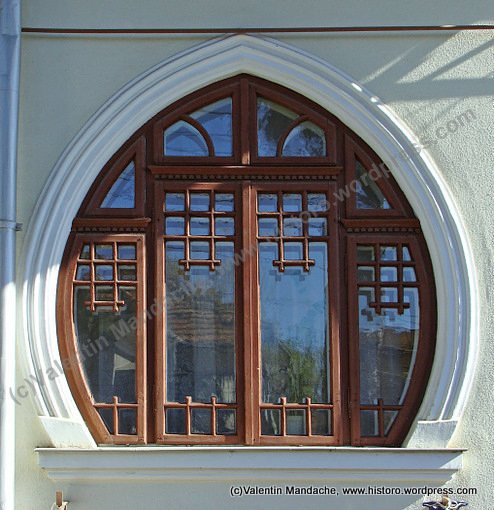
During my recent trip to Campina, an oil town 90km north of Bucharest, on the Prahova Valley, I encountered a recurrent Art Nouveau style lilac leaf motif in the window design of a number of local houses. What made it more interesting, was its popularity well beyond the Art Nouveau era, being also displayed by houses from the inter-war and WWII period. The lilac leaf motif was popular in Art Nouveau representations, being a pattern borrowed from Oriental visual arts, originating in Persian representations and also adopted throughout the Ottoman realm, of which the Romanians were an integral part for several centuries. That could explain the unusual preference for this design in a provincial town like Campina. In the photographs bellow I tried to convey a bit from the enduring favour of lilac leaf shaped windows in this corner of Romania, with meritorious examples dating from the 1900s, the Art Nouveau age, to the 1920s and the early 1940s.

Lilac leaf shaped Art Nouveau window, 1900s, Campina, southern Romania (©Valentin Mandache)
Lilac leaf shaped Art Nouveau window, 1920s, Campina, southern Romania (©Valentin Mandache)
Lilac leaf shaped Art Nouveau window, 1940s, Campina, southern Romania (©Valentin Mandache)

***********************************************

I endeavor through this daily series of daily articles to inspire appreciation of the historic houses of Romania, a virtually undiscovered, but fascinating chapter of European architectural history and heritage.

***********************************************

If you plan acquiring a historic property in Romania or start a renovation project, I would be delighted to advice you in sourcing the property, specialist research, planning permissions, restoration project management, etc. To discuss your particular plan please see my contact details in the Contactpage of this weblog.

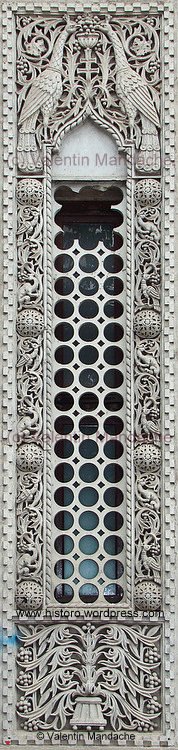
Magnificent Neo-Romanian style “Tree of Life” decorative panel

Neo-Romanian style window decoration, Piata Romana area, Bucharest. (©Valentin Mandache)

I was literally blown away when I first encountered the splendid “Three of Life” window decorative panel, shown in the photograph above, part of the elaborate decoration of a late 1920s - early 1930 Neo-Romanian style house in central Bucharest. It is still well preserved, with the exception of the upper part of the window reticular screen, which was probably broken sometimes in the last decade by ignorant proprietors to make way for air conditioning ducts, a blemish that is nevertheless repairable. The panel is in fact a complex composition of many symbols, inspired from the rich Romanian church and peasant mythology, arranged together in a succession of metaphors that unfurl along the three of life theme. I can detect there the origins of life motif in the plant pot represented on the base sector, sitting on three grains (the Trinity) from which the life sprang up as a fruit bearing vine plant. The middle sector shows life’s many paths represented by the two decorative side window dressings that illustrate the continuous Manichean encounters between the good (symbolised by the protector eagle) and evil (symbolised by the dragon) forces. Their encounters are interrupted by ornate medallions containing the symbol of the cross, epitomising the peaceful moments attained at some points in life. The upper sector is a representation of the Garden of Eden, where two peacocks, attributes of beauty and peace, feed from a fruit laden cup sustained by a double traverse cross symbolising in the Byzantine/ Orthodox imagery the triumph of Christ and therefore of life over death. The three sectors thus form together an elaborate and full of details three of life, that gives personality and meaning to the the whole architecture of the house. There are many other symbols within this wonderful assembly, like the rope unfurling on the edge of the reticular screen, symbolising the infinity, etc. The whole panel is an wonderful Neo-Romanian style design, which has found in the local church and peasant art and mythology an extraordinarily rich source of inspiration.

***********************************************

I endeavor through this series of daily articles to inspire appreciation of the historic houses of Romania, a virtually undiscovered, but fascinating chapter of European architectural history and heritage.

***********************************************

If you plan acquiring a historic property in Romania or start a renovation project, I would be delighted to advice you in sourcing the property, specialist research, planning permissions, restoration project management, etc. To discuss your particular plan please see my contact details in the Contact page of this weblog.
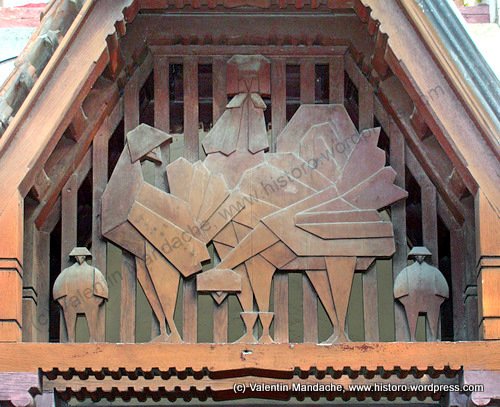
Cockerel, hens and chicks in a refined Art Deco woodwork representation

Art Deco style woodwork panel dating from the late-1930s on a doorway pediment, representing a cockerel, hens and chicks symbolising the family inhabiting that house and its domestic peace. Dorobanti area, Bucharest. (©Valentin Mandache)

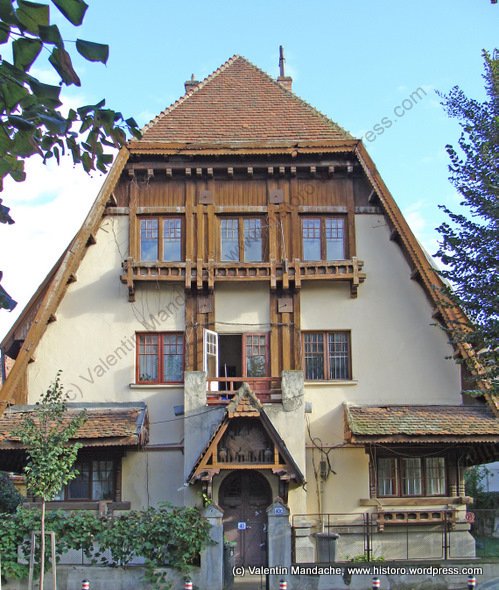
The house hosting the exquisite Art Deco panel presented here dates from the late-1930s, displaying a mixture of styles on an Alpine chalet theme, a design popular at that time in countries that came under strong German influence, as was the case of Romania. The Alpine themes in architecture were very much favoured by the German national-socialist government against the Bauhaus and International Modernist styles that flourished before their ascension to power. In Romania that type of design was perceived as originating from a more advanced and prestigious cultural environment and did not have outright political connotations as in Germany. This particular house also contains Neo-Romanian motifs (the doorway awning ornaments, the ethnographic patterns carved on the window pillars, etc.) or even Art Deco, where the most conspicuous element is the panel from the above photograph. I like the cheerfulness and high abstraction of the design and the somehow amusing hint that the man in the house had two female partners (the official wife and the mistress).

A late-1930s Alpine chalet style house embellished with an Art Deco woodwork panel on the doorway pediment representing a cockerel's family. Dorobanti area, Bucharest. (©Valentin Mandache)

***********************************************

I endeavor through this series of daily articles to inspire appreciation of the historic houses of Romania, a virtually undiscovered, but fascinating chapter of European architectural history and heritage.

***********************************************

If you plan acquiring a historic property in Romania or start a renovation project, I would be delighted to advice you in sourcing the property, specialist research, planning permissions, restoration project management, etc. To discuss your particular plan please see my contact details in the Contact page of this weblog.

Elaborate Neo-Romanian style finial

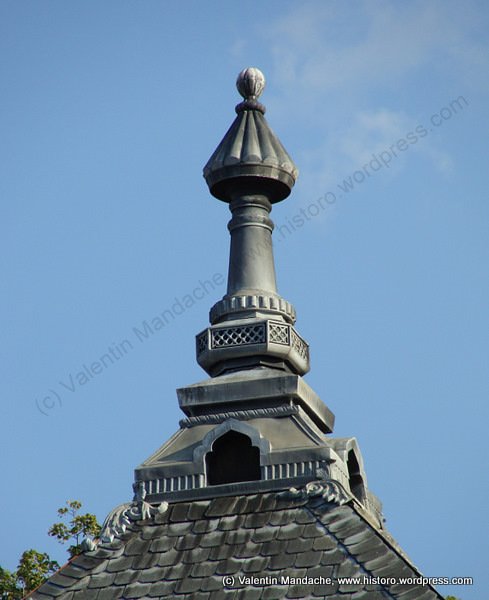
An elaborate example of Neo-Romanian style finial, early 1920s house, ASE area, Bucharest. (©Valentin Mandache)

The finial is the ornamental terminal feature at the top of a roof pinnacle or gable. The Neo-Romanian style buildings are often endowed with spectacular finials, where their design, ornament and decoration encompasses in a small space the essence and spirit of that architectural order specific to this region of Europe. I found the finial example pictured above as being one of the most elaborate and also well proportioned, which I encountered in my fieldwork in Bucharest and the rest of Romania. It has also been presented in a large photomontage and slide show of Neo-Romanian style finials, some monts ago, but I wanted to bring it back to attention with a more detailed photograph. I like the two main motifs categories making up the decorative register of this finial: the late medieval Wallachian church inspired ones such as the window-like openings at the base or the rope and the diagonal line motifs above and on the other hand the peasant art inspired motif represented by the stylisation of a hay stack crowning the finial. The whole assembly exudes confidence and a sense of history.

***********************************************

I endeavor through this series of daily articles to inspire appreciation of the historic houses of Romania, a virtually undiscovered, but fascinating chapter of European architectural history and heritage.

***********************************************

If you plan acquiring a historic property in Romania or start a renovation project, I would be delighted to advice you in sourcing the property, specialist research, planning permissions, restoration project management, etc. To discuss your particular plan please see my contact details in the Contact page of this weblog.
Art Deco Floral Motifs for Birthday Celebration

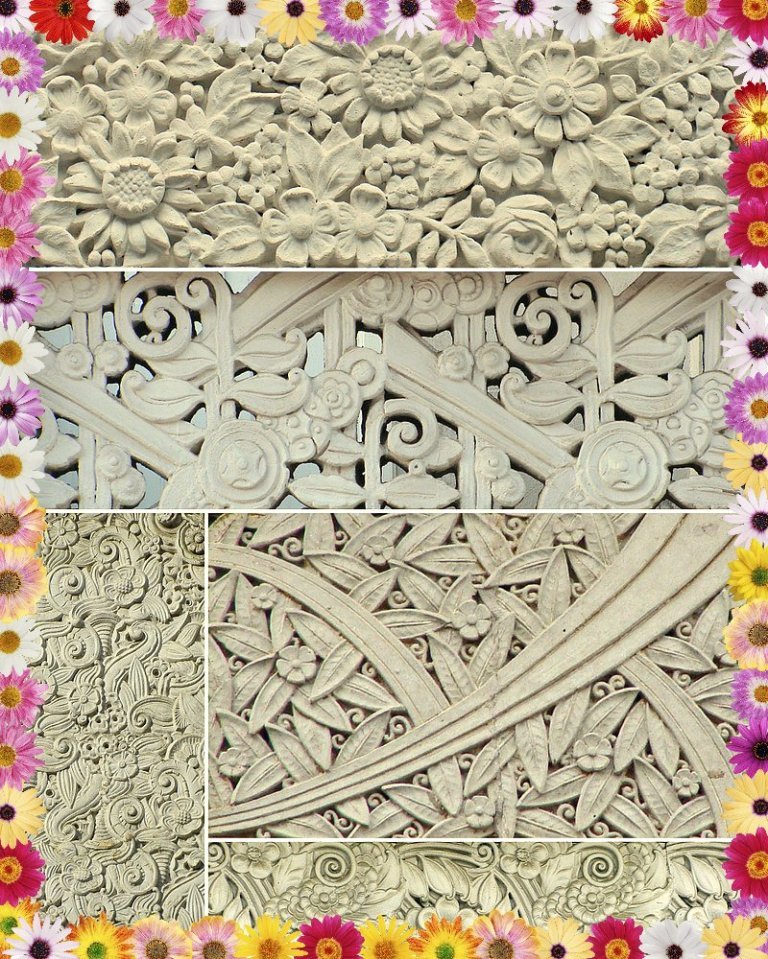
Art Deco floral panels, 1930s Bucharest (©Valentin Mandache)

My wife, Diana, celebrates today her birthday! To mark this beautiful event, I composed a photomontage and slide show of Art Deco style floral panels, which I photographed throughout the year in Bucharest. These exquisite designs adorn façades of houses dating from the 1930s, a truly golden and happy era for this city. The panels are renderings of luxuriant flowers and vegetation symbolising the paradisiac Southern Seas to which the inter-war Bucharesters, inhabitants of Europe’s austere the lower Danube prairie, where longing to travel and experience, especially during the long Siberia like winters that often engulf this region. I would like to dedicate these charming architectural ‘slices of paradise’ to Diana and wish her a very, very happy birthday!!! Valentin 🙂

This slideshow requires JavaScript.

Art Deco floral panels, Bucharest (©Valentin Mandache)

***********************************************

I endeavor through this series of daily articles to inspire appreciation of the historic houses of Romania, a virtually undiscovered, but fascinating chapter of European architectural history and heritage.

***********************************************

If you plan acquiring a historic property in Romania or start a renovation project, I would be delighted to advice you in sourcing the property, specialist research, planning permissions, restoration project management, etc. To discuss your particular plan please see my contact details in the Contact page of this weblog.
Bruegel-Like Scenes in Romanian Villages

Bruegel-like scenes in Romanian vilages (photographs by ethnographic research team led by Prof. Ioana Fruntelata and Mr. Horia Nitescu, 2006-07, Bucovina & Arges regions).

Anyone from the Western world, who plans buying a traditional country house in Romania must beforehand realise the considerable cultural differences between the host communities and the newcomers. The rural communities of Romania are still pursuing an ancestral way of life governed by highly particular religious beliefs and mythology typical of the Carpathian Mountains region, a sort of rural Europe before the Enlightenment and Industrial Revolution. It is a world even more primeval that that described by Anthony Hope in his classic fiction book ‘The Prisoner of Zenda’ as the imaginary kingdom of Ruritania, which in the western mind is associated with the old Eastern Europe. The Romanian rural communities still conserve in many aspects an ancestral mental universe and way of interpreting religion, typical of their c16th or c17th counterparts from western Europe, as is seen in the paintings of Bruegel the Elder. The excellent and very evocative photographs arranged in the above montage and slide show bellow the text depict such a Bruegel-esque atmosphere in Romanian villages in the AD 2006 - ’07. The photographs were realised during ethnography fieldwork in villages from Romania’s north-east (Bucovina) and south (Arges) by students from the Department of Ethnology and Folklore/ Faculty of Literature from the University of Bucharest, led by Prof. Ioana Fruntelata and Mr. Horia Nitescu, a fervent reader of my blog, who most kindly provided these images for publication.

This slideshow requires JavaScript.

***********************************************

I endeavor through this series of daily articles to inspire appreciation of the historic houses of Romania, a virtually undiscovered, but fascinating chapter of European architectural history and heritage.

***********************************************

If you plan acquiring a historic property in Romania or start a renovation project, I would be delighted to advice you in sourcing the property, specialist research, planning permissions, restoration project management, etc. To discuss your particular plan please see my contact details in the Contact page of this weblog.
Manichean Symbolism on Neo-Romanian Style Panels

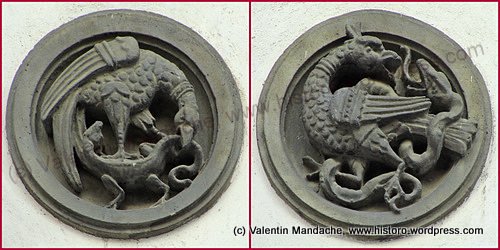
Neo-Romanian style circular decorative panels with Manichean representations: the battle between good (eagle) and evil (reptiles) adorning the street wall of an early 1930s house in Stirbey Voda area, Bucharest. (©Valentin Mandache)

The Romanian folklore and traditional peasant beliefs, as well as the indigenous brand of Christianity (officially denominated as “Greek Christianity”, in reality very much blended with local ancient pagan beliefs) contain many references to epic Manichean battles between the good and evil forces. One of the usual representations in the Romanian visual arts of the good forces is that of the protector eagle, while the evil forces are symbolised by reptiles- snakes or dragon like lizards. I found two very telling such representations in the form of the circular architectural panels presented in the photographs above, which adorn the street wall of a grand Neo-Romanian style house in one of the central quarters of Bucharest. I am just overwhelmed by the dynamism and drama of these two well rendered scenes, in which the protagonists are clutched in a deadly fight, with no clear winner in sight. These two panels are some of the finest Neo-Romanian style Manichean symbolism representations that I encountered so far in my architectural photography work in Bucharest; another similar theme panel can be seen here, about which I wrote a post in June this year.

***********************************************

I endeavor through this series of daily articles to inspire appreciation of the historic houses of Romania, a virtually undiscovered, but fascinating chapter of European architectural history and heritage.

***********************************************

If you plan acquiring a historic property in Romania or start a renovation project, I would be delighted to advice you in sourcing the property, specialist research, planning permissions, restoration project management, etc. To discuss your particular plan please see my contact details in the Contact page of this weblog.